Let's Talk Battery Pricing
Apr 23, 2026
Let’s talk Battery Pricing!
Why is working out the price for a used EV battery so confusing? Why are there such variations in price? In this blog, we’re going to explain why variations in supply and demand have created such a dynamic pricing market.
The price of an End-of-Life (EOL) EV battery (EVB) is, as with any product, influenced by production costs, competition, perceived value and, of course, market supply and demand.
There is the cost of making the EV battery in the first place to be considered – the raw materials, labour and logistics involved in getting the EVB on the road and off it again at EOL.
There is the level of competition in the market. There are EVBs for hundreds of different car models and potentially thousands of EVBs coming towards EOL as the electric vehicle market matures.
On the face of it, such high competition would suggest this helps keep prices relatively low, but the EVB market is more nuanced than that. If someone is looking for a very specific EVB from a rarer car model, that could, potentially, hold a higher price (but we stress, potentially).
This brings us to perceived value – what customers think the product should be worth. This could be influenced by a past product pricing seen in the market (although, to the previous point, the rarity, or otherwise, of the product might mean it’s a case of comparing apples with oranges!).
And this is why it’s all so confusing. The same product can be listed at very different price points. A similar product might be listed at a very different price point.
And the truth is, this might accurately reflect its value, based on the supply and demand in the market. And this is where the nuances really come in.
EOL EVBs are complicated. You have different types, attracted by different buyers. Quality is more complicated than with many other products. Some buyers are interested in the battery’s State of Health. Others, its State of Charge. Others, its particular chemistry. Others, the volumes of batteries available.
Like I say, it’s complicated! So, in simple terms, who is on the demand side of the battery transaction?
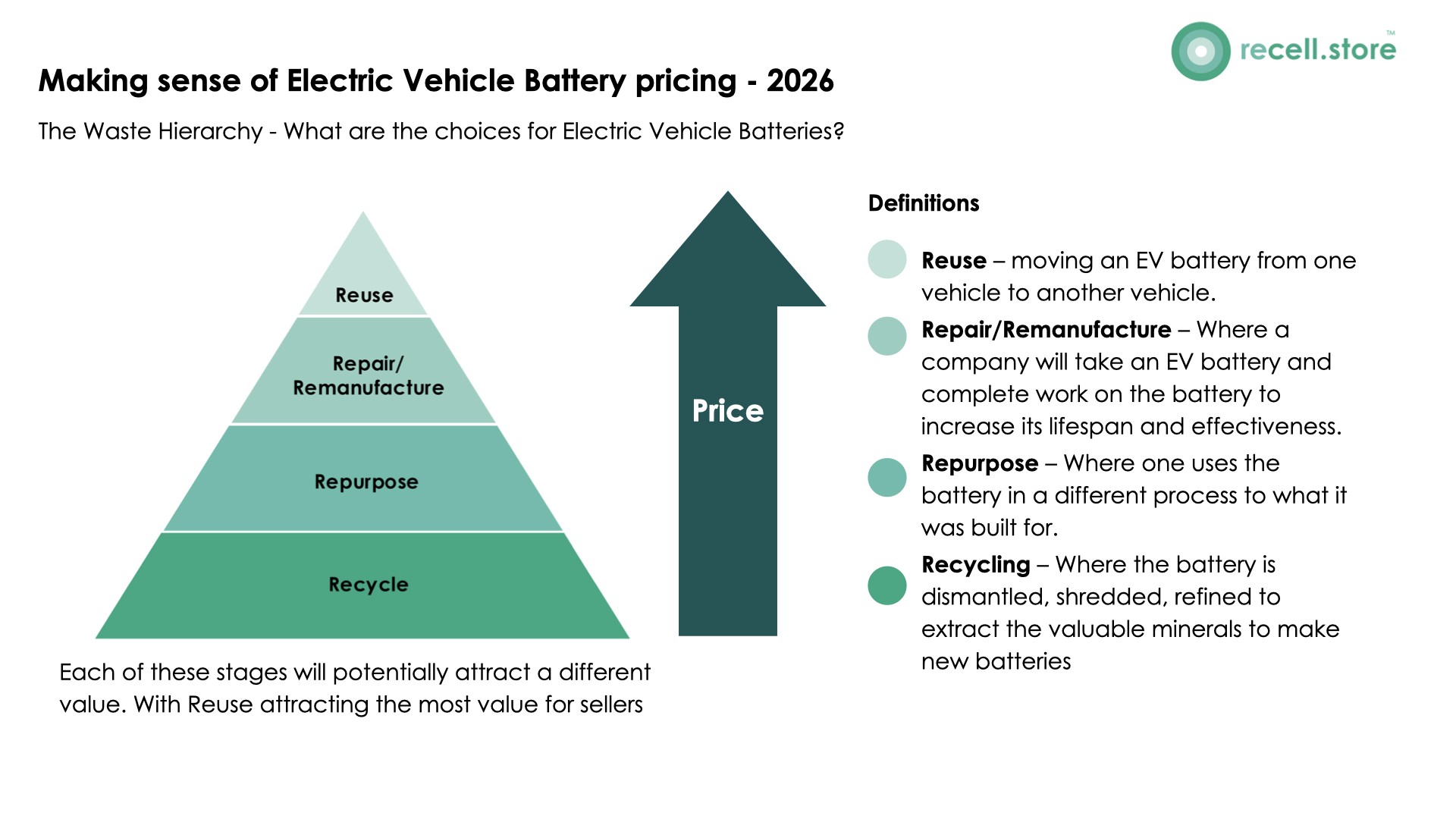
• Re-use – Customers who are looking to buy a particular type of battery to replace a battery in a specific vehicle.
• Repurpose – Those that are looking to use that battery for another reason other than what the battery was manufactured for, normally for Battery Energy Storage Systems (BESS).
• Recycling – Businesses that will break the battery down, through a series of processes, to extract the minerals/metals for recycling to make new EVBs.
All three want batteries, but for different reasons. And all three have different component costs involved depending on where the batteries are and what they want to do with them, and that drives a different value for each customer, and hence such variable pricing.
Consider someone who has a BMW i3 and needs to replace that battery. They can only purchase one type of battery and that battery needs to be of a decent quality.
Someone purchasing a battery for Energy Storage is more concerned with its charge capacity (i.e. how many KWHs the battery currently has) and, because the battery was designed for a car rather than energy storage, the costs of adapting that battery.
With recycling, they are interested in the battery chemistry, what the battery is made of, how much nickel, cobalt and other precious metals are in the battery. They are not concerned with KWH, but they have greater costs to consider. The costs of dismantling, shredding, and refining that EOL EVB to produce a pure battery ready material that can be sold back into the battery supply chain.
So, in summary, we different levels of battery quality, different capacity, different costs and different reasons driving demand, regardless of the market supply.
So, how do you apply a price to a battery?
Someone told me this week (others may have a different view) that 90% of batteries are sold to BESS operators or recycled. This means that only 10% of EVBs are re-used in vehicles.
This makes sense when you consider that batteries are lasting much longer than people assumed, often beyond the life of the vehicle itself. There is not the level of demand to find a home for all EOL batteries in the re-use market.
As such, anyone selling a battery needs to consider who their potential buyers are and price accordingly.
Pricing for the re-use market will probably yield the best price, but demand might be low. It’s a bit like finding a collector for a rare piece of art. You might have to hold onto your collection until the right buyer comes along.
Pricing for the repurpose market will attract more buyers, but it’s likely you’ll need to come down in price. Volume can be a benefit here, and if you have a lot of batteries you want out of storage quickly, this is the best way to get them moving.
Finally, recognising that pricing for the recycling market is driven by commodity and complex processing costs and means the price is likely to be its lowest is helpful (but if you really want to move your batteries, and do the right thing, this is a viable option).
The upshot of all of this is there is no single battery ‘price’. Value depends entirely on end use + condition + the cost to unlock that value. The winner isn’t who has the best battery – it’s who matches the battery to the right buyer fastest and most efficiently (our mission here at recell.store).
So instead of:
“What is this battery worth?”
The real question is:
“Who is the highest-paying viable buyer for this battery, given its condition and the costs of moving it or storing it?”
I’d love to hear your thoughts. Drop me a line at simon@recell.store
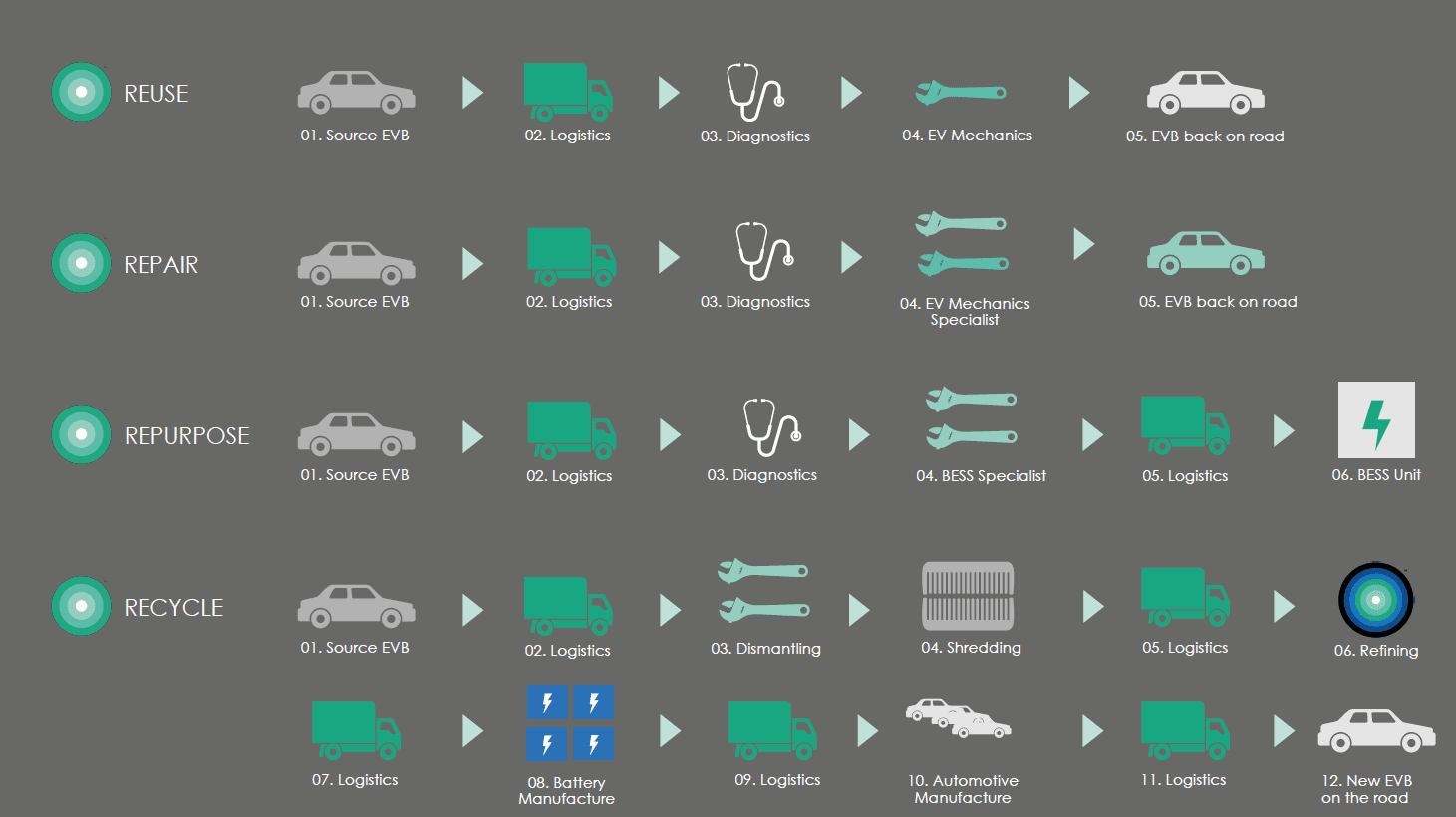
ABOVE: The key components for different EVB customers