


Pricing
Pricing
The price of an End-of-Life (EOL) EV battery (EVB) is, as with any product, influenced by production costs, competition and, of course, market supply and demand.
There is the cost of making the EV battery in the first place to be considered - the raw materials, labour and logistics involved in getting the EVB on the road and off it again at EOL.
There is the level of competition in the market. There are EVBs for hundreds of different car models and potentially thousands of EVBs coming towards EOL as the electric vehicle market matures.
On the face of it, such high competition would suggest this helps keep prices relatively low, but the EVB market is more nuanced than that.
Different products attract different buyers. The same product can attract different buyer demands. Quality is more complicated than with many other products. Some buyers are interested in the battery’s State of Health. Others, its State of Charge. Others, its particular chemistry. Others, the volumes of batteries available.
Access historical ABI charts here
Methodology and Specifications Guide for the ABI (All Battery Index)
Overview
The All Battery Index (ABI) is the UK's first dedicated pricing index for used electric vehicle (EV) battery packs at end-of-life. Published by Recell.Store, the ABI provides a robust and transparent reference point for participants across the EV battery value chain, including repurposers, recyclers, insurers, and fleet operators seeking to assess fair market value of used battery packs on a consistent basis.
The ABI is published every four weeks and reflects average market values based on advertised used EV battery pack prices, adjusted using Recell’s proprietary grading and pricing framework. The ABI ensures market participants can reference an independent, structured valuation model that includes key physical and economic parameters relevant to second-life use and recycling.
Specification and Scope
The ABI reflects spot market values of used EV battery packs, as offered in the UK, and is based on the following criteria:
- Location: UK (ex-works)
- Product: EV lithium-ion battery packs (NMC, LFP, etc.) from passenger vehicles
- Condition: Varies by reported and/or assessed State of Health (SOH), State of Charge (SOC), and usability
- Currency: GBP (£)
- Timing: Values updated every 4 weeks
- Transportation: Not included in index reference prices
Base Price and Adjustment Mechanism
The Base Price for ABI is set at £0 (nil) as of 1 May 2025, which corresponds to the ex-works price for a new battery pack, net of value for second-life or recycling purposes.
From this baseline, the ABI is adjusted upwards or downwards using a transparent framework that incorporates:
- Market surveys of advertised prices for used EV battery packs across public and private sales channels
- Recell.store’s proprietary grading system, which factors in:
- Remaining capacity (SOH)
- Initial SOC at time of offer
- Pack size (kWh)
- Estimated recoverable metal value
- Recyclability and disposal liabilities
- Repurposing suitability
A positive ABI value indicates the battery has a net market value (payable).
A negative ABI value indicates a net disposal liability (gate fee).
Grading System: ABI “R Grade”
Battery packs are classified into R Grades, providing a standardized quality benchmark for repurposers and recyclers:
Note: Battery listings with no available data on condition, chemistry, SOH, or SOC are defaulted to R1 status.
Survey and Data Collection Process
Recell compiles price data from:
- Online marketplaces (B2B and B2C)
- Battery resellers and repair firms
- Automotive breakers and scrapyards
- Black Mass Shredders
All prices are verified for authenticity and alignment with published specifications where available. Recell analysts also apply valuation judgment to normalize outliers and adjust for missing data.
Aggregation and Publication
ABI values are presented by battery model or pack type, including key parameters and assigned R Grade.
Future Updates and Enhancements
Future releases of the ABI methodology will include:
- Commentary on EV battery market in the UK.
- Detailed ABI “R Grade” guidelines with diagnostics calibration
- Multi-pack valuation methods for fleet decommissioning
- Pricing spread analysis between battery chemistries (e.g. NMC vs LFP).
Purpose and Use
The ABI is intended as an independent benchmark to:
- Support fair-market transactions
- Enable bankable contracts and warranties for 2nd life batteries
- De-risk investment in circular economy infrastructure
- Improve transparency in the battery disposal and recycling chain
Like grading in the insurance or used vehicle markets, ABI classification supports a transition to a professionalised, liquid secondary market for EV batteries.
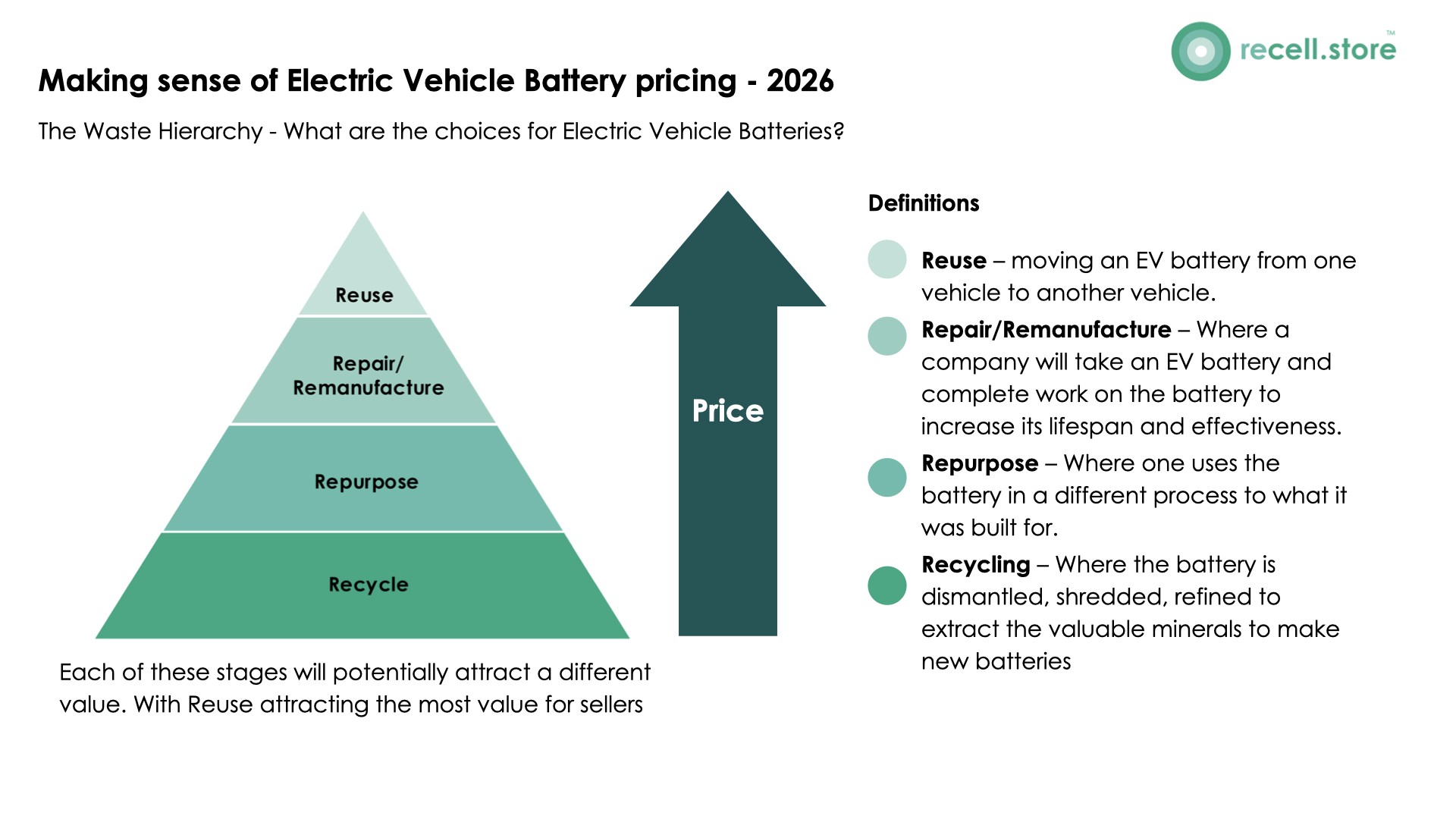
In simple terms, demand can be categorised as follows:
Re-use - Customers who are looking to buy a particular type of battery to replace a battery in a specific vehicle.
Repurpose - Those that are looking to use that battery for another reason other than what the battery was manufactured for, normally for Battery Energy Storage Systems (BESS).
Recycling - Businesses that will break the battery down, through a series of processes, to extract the minerals/metals for recycling to make new EVBs.
All three want batteries, but for different reasons. And all three have different component costs involved depending on where the batteries are and what they want to do with them, and that drives a different value for each customer, and hence such variable pricing.
Pricing for the re-use market will probably yield the best price, but demand might be low. It’s a bit like finding a collector for a rare piece of art. You might have to hold onto your collection until the right buyer comes along.
Pricing for the repurpose market will attract more buyers, but it’s likely you’ll need to come down in price. Volume can be a benefit here, and if you have a lot of batteries you want out of storage quickly, this is the best way to get them moving.
Finally, recognising that pricing for the recycling market is driven by commodity and complex processing costs and means the price is likely to be its lowest is helpful (but if you really want to move your batteries, and do the right thing, this is a viable option).
Access historical ABI charts here
Methodology and Specifications Guide for the ABI (All Battery Index)
Overview
The All Battery Index (ABI) is the UK's first dedicated pricing index for used electric vehicle (EV) battery packs at end-of-life. Published by Recell.Store, the ABI provides a robust and transparent reference point for participants across the EV battery value chain, including repurposers, recyclers, insurers, and fleet operators seeking to assess fair market value of used battery packs on a consistent basis.
The ABI is published every four weeks and reflects average market values based on advertised used EV battery pack prices, adjusted using Recell’s proprietary grading and pricing framework. The ABI ensures market participants can reference an independent, structured valuation model that includes key physical and economic parameters relevant to second-life use and recycling.
Specification and Scope
The ABI reflects spot market values of used EV battery packs, as offered in the UK, and is based on the following criteria:
- Location: UK (ex-works)
- Product: EV lithium-ion battery packs (NMC, LFP, etc.) from passenger vehicles
- Condition: Varies by reported and/or assessed State of Health (SOH), State of Charge (SOC), and usability
- Currency: GBP (£)
- Timing: Values updated every 4 weeks
- Transportation: Not included in index reference prices
Base Price and Adjustment Mechanism
The Base Price for ABI is set at £0 (nil) as of 1 May 2025, which corresponds to the ex-works price for a new battery pack, net of value for second-life or recycling purposes.
From this baseline, the ABI is adjusted upwards or downwards using a transparent framework that incorporates:
- Market surveys of advertised prices for used EV battery packs across public and private sales channels
- Recell.store’s proprietary grading system, which factors in:
- Remaining capacity (SOH)
- Initial SOC at time of offer
- Pack size (kWh)
- Estimated recoverable metal value
- Recyclability and disposal liabilities
- Repurposing suitability
A positive ABI value indicates the battery has a net market value (payable).
A negative ABI value indicates a net disposal liability (gate fee).
Grading System: ABI “R Grade”
Battery packs are classified into R Grades, providing a standardized quality benchmark for repurposers and recyclers:
Note: Battery listings with no available data on condition, chemistry, SOH, or SOC are defaulted to R1 status.
Survey and Data Collection Process
Recell compiles price data from:
- Online marketplaces (B2B and B2C)
- Battery resellers and repair firms
- Automotive breakers and scrapyards
- Black Mass Shredders
All prices are verified for authenticity and alignment with published specifications where available. Recell analysts also apply valuation judgment to normalize outliers and adjust for missing data.
Aggregation and Publication
ABI values are presented by battery model or pack type, including key parameters and assigned R Grade.
Future Updates and Enhancements
Future releases of the ABI methodology will include:
- Commentary on EV battery market in the UK.
- Detailed ABI “R Grade” guidelines with diagnostics calibration
- Multi-pack valuation methods for fleet decommissioning
- Pricing spread analysis between battery chemistries (e.g. NMC vs LFP).
Purpose and Use
The ABI is intended as an independent benchmark to:
- Support fair-market transactions
- Enable bankable contracts and warranties for 2nd life batteries
- De-risk investment in circular economy infrastructure
- Improve transparency in the battery disposal and recycling chain
Like grading in the insurance or used vehicle markets, ABI classification supports a transition to a professionalised, liquid secondary market for EV batteries.
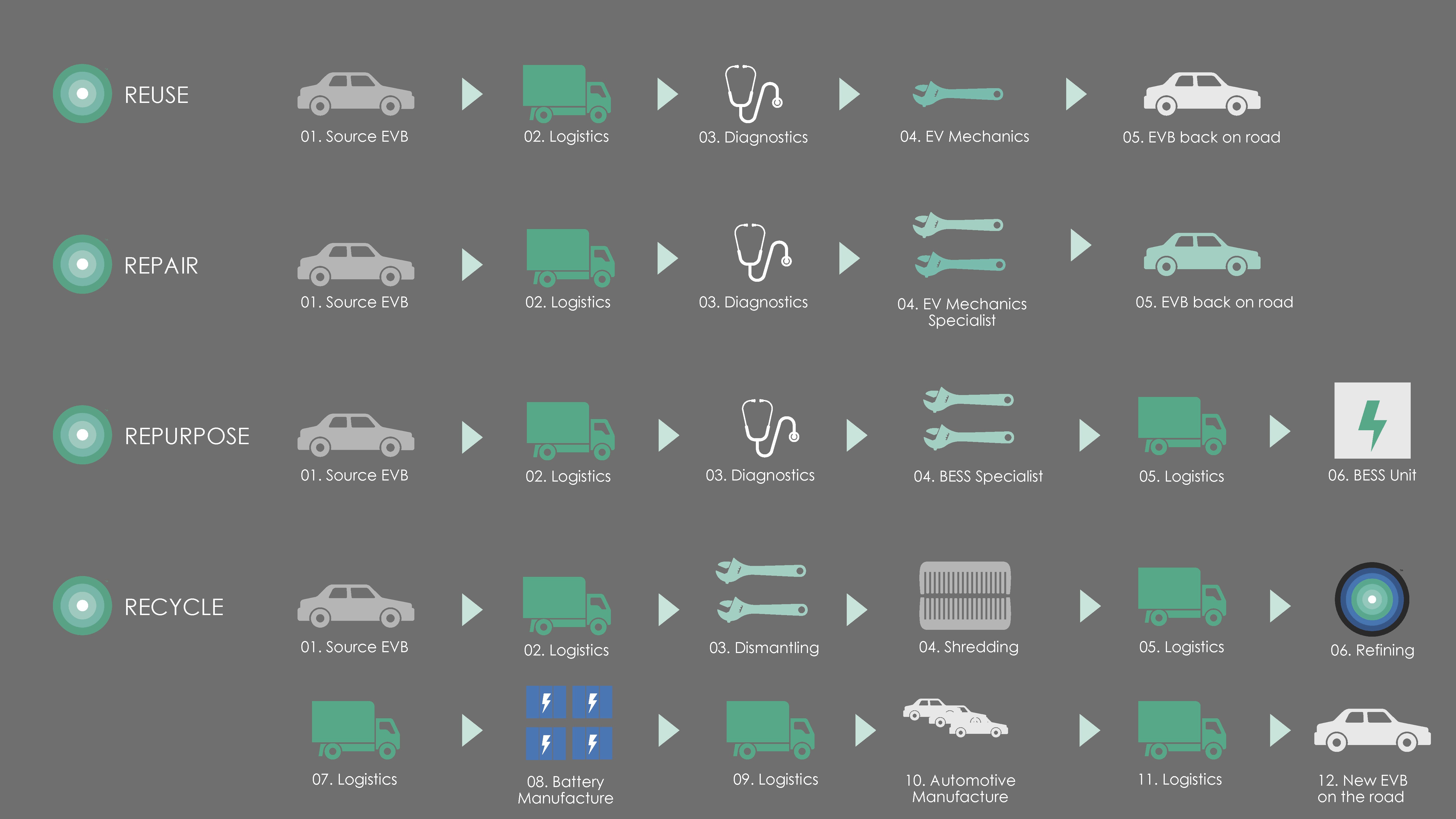
The upshot of all of this is there is no single battery 'price'. Value depends entirely on end use + condition + the cost to unlock that value. The winner isn't who has the best battery - it's who matches the battery to the right buyer fastest and most efficiently (our mission here at recell.store).
Access historical ABI charts here
Methodology and Specifications Guide for the ABI (All Battery Index)
Overview
The All Battery Index (ABI) is the UK's first dedicated pricing index for used electric vehicle (EV) battery packs at end-of-life. Published by Recell.Store, the ABI provides a robust and transparent reference point for participants across the EV battery value chain, including repurposers, recyclers, insurers, and fleet operators seeking to assess fair market value of used battery packs on a consistent basis.
The ABI is published every four weeks and reflects average market values based on advertised used EV battery pack prices, adjusted using Recell’s proprietary grading and pricing framework. The ABI ensures market participants can reference an independent, structured valuation model that includes key physical and economic parameters relevant to second-life use and recycling.
Specification and Scope
The ABI reflects spot market values of used EV battery packs, as offered in the UK, and is based on the following criteria:
- Location: UK (ex-works)
- Product: EV lithium-ion battery packs (NMC, LFP, etc.) from passenger vehicles
- Condition: Varies by reported and/or assessed State of Health (SOH), State of Charge (SOC), and usability
- Currency: GBP (£)
- Timing: Values updated every 4 weeks
- Transportation: Not included in index reference prices
Base Price and Adjustment Mechanism
The Base Price for ABI is set at £0 (nil) as of 1 May 2025, which corresponds to the ex-works price for a new battery pack, net of value for second-life or recycling purposes.
From this baseline, the ABI is adjusted upwards or downwards using a transparent framework that incorporates:
- Market surveys of advertised prices for used EV battery packs across public and private sales channels
- Recell.store’s proprietary grading system, which factors in:
- Remaining capacity (SOH)
- Initial SOC at time of offer
- Pack size (kWh)
- Estimated recoverable metal value
- Recyclability and disposal liabilities
- Repurposing suitability
A positive ABI value indicates the battery has a net market value (payable).
A negative ABI value indicates a net disposal liability (gate fee).
Grading System: ABI “R Grade”
Battery packs are classified into R Grades, providing a standardized quality benchmark for repurposers and recyclers:
Note: Battery listings with no available data on condition, chemistry, SOH, or SOC are defaulted to R1 status.
Survey and Data Collection Process
Recell compiles price data from:
- Online marketplaces (B2B and B2C)
- Battery resellers and repair firms
- Automotive breakers and scrapyards
- Black Mass Shredders
All prices are verified for authenticity and alignment with published specifications where available. Recell analysts also apply valuation judgment to normalize outliers and adjust for missing data.
Aggregation and Publication
ABI values are presented by battery model or pack type, including key parameters and assigned R Grade.
Future Updates and Enhancements
Future releases of the ABI methodology will include:
- Commentary on EV battery market in the UK.
- Detailed ABI “R Grade” guidelines with diagnostics calibration
- Multi-pack valuation methods for fleet decommissioning
- Pricing spread analysis between battery chemistries (e.g. NMC vs LFP).
Purpose and Use
The ABI is intended as an independent benchmark to:
- Support fair-market transactions
- Enable bankable contracts and warranties for 2nd life batteries
- De-risk investment in circular economy infrastructure
- Improve transparency in the battery disposal and recycling chain
Like grading in the insurance or used vehicle markets, ABI classification supports a transition to a professionalised, liquid secondary market for EV batteries.
The All Battery Index (ABI)
Overview
The All Battery Index (ABI) is the UK's first dedicated pricing index for used electric vehicle (EV) battery packs at end-of-life. Published by recell.store, the ABI provides a robust and transparent reference point for participants across the EV battery value chain, including repurposers, recyclers, insurers and fleet operators seeking to assess fair market value of used battery packs on a consistent basis.
The ABI reflects average market values based on advertised used EV battery pack prices, adjusted using recell's proprietary grading and pricing framework. The ABI ensures market participants can reference an independent, structured valuation model that includes key physical and economic parameters relevant to second-life use and recycling.
Access historical ABI charts here
Methodology and Specifications Guide for the ABI (All Battery Index)
Overview
The All Battery Index (ABI) is the UK's first dedicated pricing index for used electric vehicle (EV) battery packs at end-of-life. Published by Recell.Store, the ABI provides a robust and transparent reference point for participants across the EV battery value chain, including repurposers, recyclers, insurers, and fleet operators seeking to assess fair market value of used battery packs on a consistent basis.
The ABI is published every four weeks and reflects average market values based on advertised used EV battery pack prices, adjusted using Recell’s proprietary grading and pricing framework. The ABI ensures market participants can reference an independent, structured valuation model that includes key physical and economic parameters relevant to second-life use and recycling.
Specification and Scope
The ABI reflects spot market values of used EV battery packs, as offered in the UK, and is based on the following criteria:
- Location: UK (ex-works)
- Product: EV lithium-ion battery packs (NMC, LFP, etc.) from passenger vehicles
- Condition: Varies by reported and/or assessed State of Health (SOH), State of Charge (SOC), and usability
- Currency: GBP (£)
- Timing: Values updated every 4 weeks
- Transportation: Not included in index reference prices
Base Price and Adjustment Mechanism
The Base Price for ABI is set at £0 (nil) as of 1 May 2025, which corresponds to the ex-works price for a new battery pack, net of value for second-life or recycling purposes.
From this baseline, the ABI is adjusted upwards or downwards using a transparent framework that incorporates:
- Market surveys of advertised prices for used EV battery packs across public and private sales channels
- Recell.store’s proprietary grading system, which factors in:
- Remaining capacity (SOH)
- Initial SOC at time of offer
- Pack size (kWh)
- Estimated recoverable metal value
- Recyclability and disposal liabilities
- Repurposing suitability
A positive ABI value indicates the battery has a net market value (payable).
A negative ABI value indicates a net disposal liability (gate fee).
Grading System: ABI “R Grade”
Battery packs are classified into R Grades, providing a standardized quality benchmark for repurposers and recyclers:
Note: Battery listings with no available data on condition, chemistry, SOH, or SOC are defaulted to R1 status.
Survey and Data Collection Process
Recell compiles price data from:
- Online marketplaces (B2B and B2C)
- Battery resellers and repair firms
- Automotive breakers and scrapyards
- Black Mass Shredders
All prices are verified for authenticity and alignment with published specifications where available. Recell analysts also apply valuation judgment to normalize outliers and adjust for missing data.
Aggregation and Publication
ABI values are presented by battery model or pack type, including key parameters and assigned R Grade.
Future Updates and Enhancements
Future releases of the ABI methodology will include:
- Commentary on EV battery market in the UK.
- Detailed ABI “R Grade” guidelines with diagnostics calibration
- Multi-pack valuation methods for fleet decommissioning
- Pricing spread analysis between battery chemistries (e.g. NMC vs LFP).
Purpose and Use
The ABI is intended as an independent benchmark to:
- Support fair-market transactions
- Enable bankable contracts and warranties for 2nd life batteries
- De-risk investment in circular economy infrastructure
- Improve transparency in the battery disposal and recycling chain
Like grading in the insurance or used vehicle markets, ABI classification supports a transition to a professionalised, liquid secondary market for EV batteries.
The price of an End-of-Life (EOL) EV battery (EVB) is, as with any product, influenced by production costs, competition and, of course, market supply and demand.
There is the cost of making the EV battery in the first place to be considered - the raw materials, labour and logistics involved in getting the EVB on the road and off it again at EOL.
There is the level of competition in the market. There are EVBs for hundreds of different car models and potentially thousands of EVBs coming towards EOL as the electric vehicle market matures.
On the face of it, such high competition would suggest this helps keep prices relatively low, but the EVB market is more nuanced than that.
Different products attract different buyers. The same product can attract different buyer demands. Quality is more complicated than with many other products. Some buyers are interested in the battery’s State of Health. Others, its State of Charge. Others, its particular chemistry. Others, the volumes of batteries available.
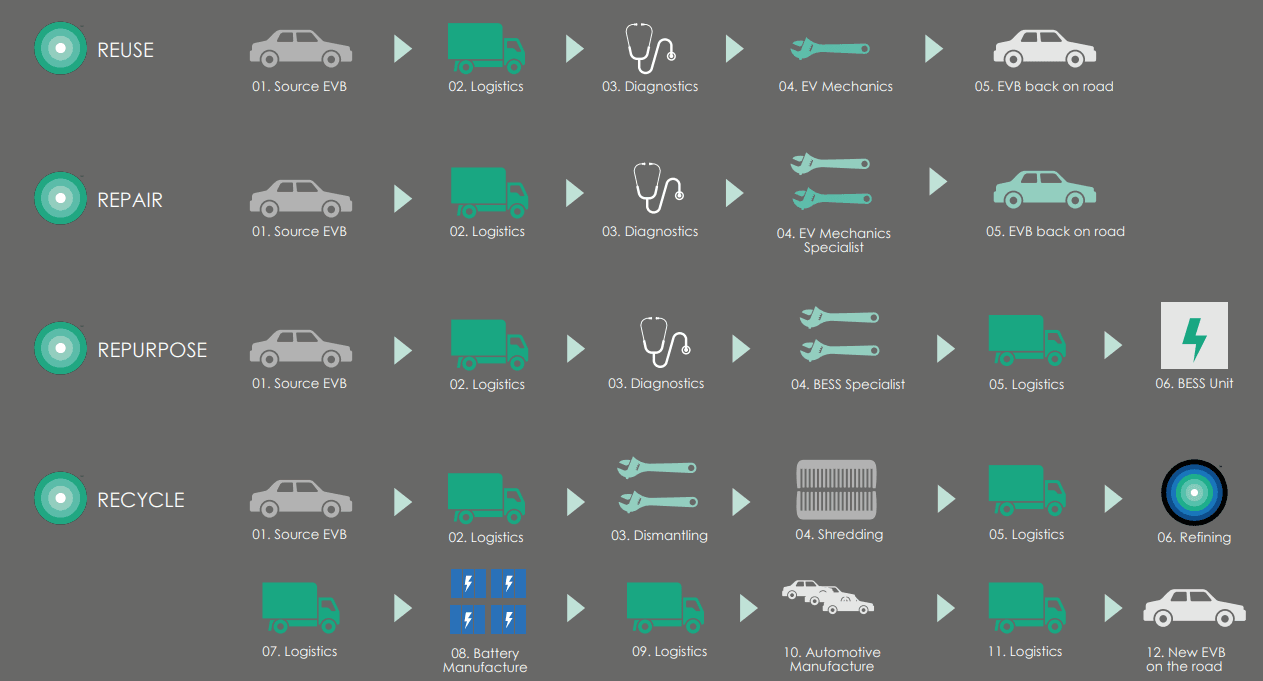
In simple terms, demand can be categorised as follows:
Re-use - Customers who are looking to buy a particular type of battery to replace a battery in a specific vehicle.
Repurpose - Those that are looking to use that battery for another reason other than what the battery was manufactured for, normally for Battery Energy Storage Systems (BESS).
Recycling - Businesses that will break the battery down, through a series of processes, to extract the minerals/metals for recycling to make new EVBs.
All three want batteries, but for different reasons. And all three have different component costs involved depending on where the batteries are and what they want to do with them, and that drives a different value for each customer, and hence such variable pricing.
Pricing for the re-use market will probably yield the best price, but demand might be low. It’s a bit like finding a collector for a rare piece of art. You might have to hold onto your collection until the right buyer comes along.
Pricing for the repurpose market will attract more buyers, but it’s likely you’ll need to come down in price. Volume can be a benefit here, and if you have a lot of batteries you want out of storage quickly, this is the best way to get them moving.
Finally, recognising that pricing for the recycling market is driven by commodity and complex processing costs and means the price is likely to be its lowest is helpful (but if you really want to move your batteries, and do the right thing, this is a viable option).
The upshot of all of this is there is no single battery 'price'. Value depends entirely on end use + condition + the cost to unlock that value. The winner isn't who has the best battery - it's who matches the battery to the right buyer fastest and most efficiently (our mission here at recell.store).
The All Battery Index (ABI)
Overview
The All Battery Index (ABI) is the UK's first dedicated pricing index for used electric vehicle (EV) battery packs at end-of-life. Published by recell.store, the ABI provides a robust and transparent reference point for participants across the EV battery value chain, including repurposers, recyclers, insurers and fleet operators seeking to assess fair market value of used battery packs on a consistent basis.
The ABI reflects average market values based on advertised used EV battery pack prices, adjusted using recell's proprietary grading and pricing framework. The ABI ensures market participants can reference an independent, structured valuation model that includes key physical and economic parameters relevant to second-life use and recycling.
